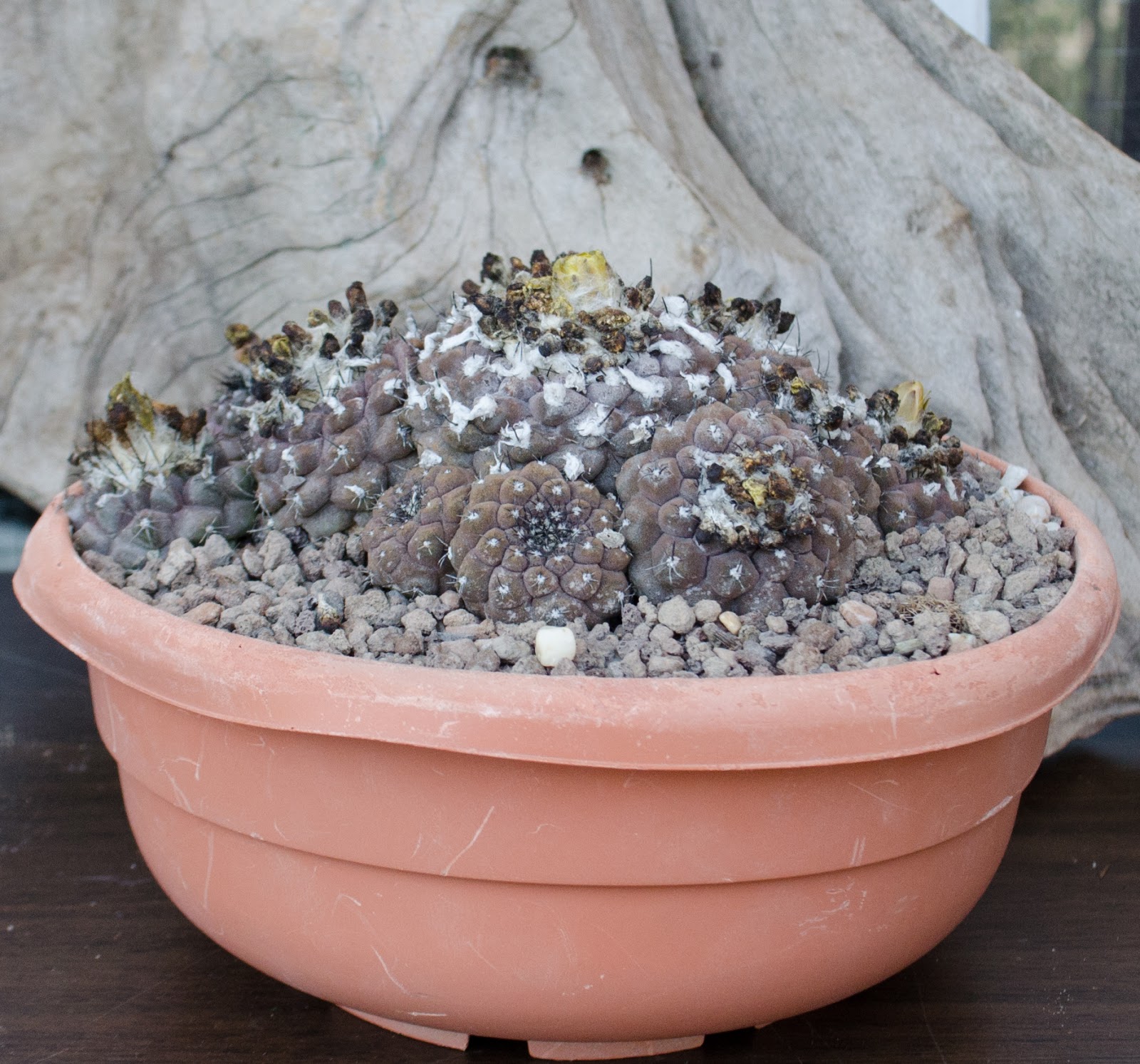
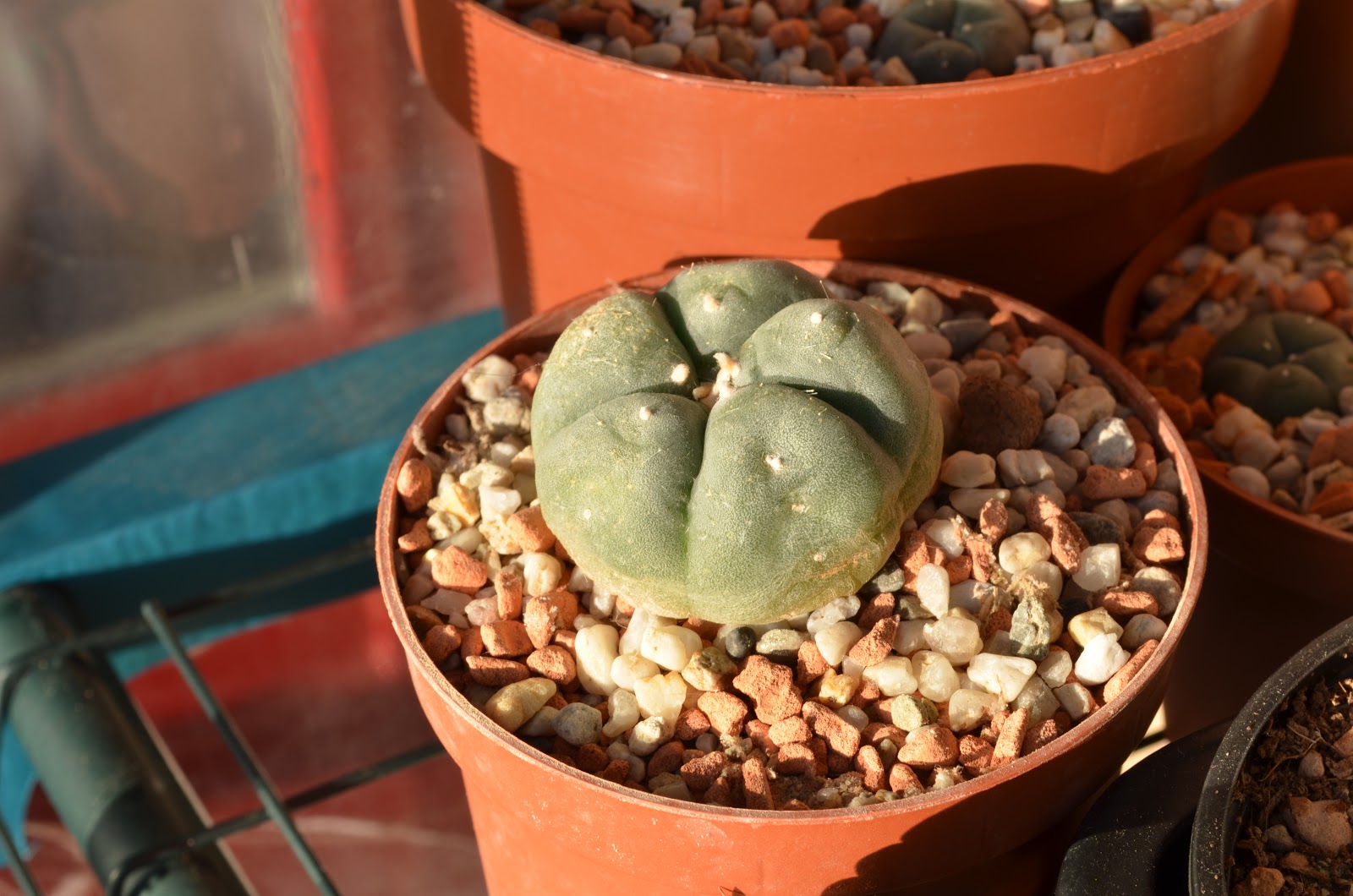
Hi there! Here's another post about another flowering cactus. This time, I'm talking about one of my Peyotes, that has unexpectedly surprised me with a very small, white-pinkish flower. This is my first flowering Peyote. I've bought this plant back in 2014 from "Danny de Cactus", a shop in Rotterdam.
Flowering Peyote (Lophophora williamsii var. caespitosa)
It's a Lophophora williamsii var. caespitosa(caespitosa means growing in clusters). In my opinion, this is not a variety, but a form. Let's say that I'm not yet convinced it is a variety. I've bought and sown some L. williamsii var. caespitosa seeds in 2012 and If they'll all (or at least a couple of them) grow clusters in the near future, I'll accept that it is a variety and not a form.
Lophophora williamsii's natural habitat stretches out from the state Texas (USA) to San Luis Potosi (Mexico). It's a spineless cactus that mainly grows solitary, but sometimes grow clusters (like the one I'm showing you right here). This plant has a worldwide reputation for being a strong psychedelic hallucinogen. Like I've mentioned in some of my previous posts, this plant is used during shamanistic rituals by some Native American tribes.
I'm not going to write a complete essay on this plant, because there is already soo much info online on this little friend (CHECK).
Flowering Peyote (Lophophora williamsii var. caespitosa)
I own this plant for only two years and to understand how small the flower is, you should know that this plant has a diameter of only 5 cm. Although the flower is a bit crooked, I'm still glad to see that my "work" is paying off. I can't wait to have more Peyotes flowering at the same time so that I can try some pollination!
That's it for today. Meanwhile, two other plants are flowering; one Rhipsalis elliptica and (again) my Copiapoa hypogaea var. barquitensis. The latter only has two flowers at the moment. It's actually flowering throughout all summer, but not as abundant as in June (see one of my previous posts HERE). I'm not sure if I'll be able to show you more flowering plants this year, so there's a big chance my next blog will be about Bock beer, whisky and/or pipes. Take care!
Góðan dag! Today's post is all about new additions to my cactus & other succulent collection and about the day trip to the Ubink Cactus & Succulent nursery with my two-year-old son.
Lophophora williamsii
Each year, there's an event called 'Cactus & Vetplantendag' at Ubink's, which means: 'Cactus and Succulent day'. This was my second time and my son's first (!). I already knew that I wouldn't be able to take a lot of pics this time, other than the ones of Arthur running around in this gigantic greenhouse and a video where he disappears in a group of 4 meter high cereuses.
I haven't taken any pics, so I'm going to describe the place with words and then show you some photos of my purchases.
What can I say about the nursery? It's a really big greenhouse that covers over 60.000 square meters and it's filled with succulent plants. Once a year it's open for hobbyists, who are then able to buy plants for a very decent price. You probably can imagine that I felt like a kid in a candy store! One part of the greenhouse was reserved for hobby breeders to sell their plants. The perfect place to find pretty and rare species. Man, I loved it over there, but Arthur loved it even more. Totally worth it!
It took us 3 hours to get in Kudelstaart, but even the trip alone was more than worth it: my son swore that he saw a squirrel in the trees from the train and a little later he even saw a hippopotamus! The Dutch fauna keeps amazing me...
Around 12 am we arrived at the nursery. Arthur was really impressed: "Oh! Cactusbeurs! Yes! Look at all those Cactuses!". The entrance was recognizable by a beautiful cactus garden. Inside we were welcomed with some refreshments (coffee and lemonade) before we both went berserk.
Of course, I can try to describe each path and all the species inside the nursery, but instead of wasting our time, I'm going to show you the same video as I did in 2014:
I'm very aware that it's a bad quality video and I only post it to give you a small impression, so please don't give it anymore thumbs-down on YouTube! I got one thumb down and it has made me sad for at least half a second. ;-) By the way: my son loves this video and always asks me to show it (must be Nino Rota's funny music combined with the turbo mode).
It was a little bit harder to check out all the plants this time, so we had to walk by at least 20 times before being able to choose what to buy, but I don't mind. We had a great time! After 3 hours of fun, laughter, a lot of running and buying, we went home with the following purchases:
Euphorbia pugniformis
Euphorbia pugniformis
This is the second Medusoid species of the Euphorbia family that I've added to my collection. In 2014 I've purchased an E. gorgonis from the same nice man at that year's 'Cactus & Succulent day'. E. pugniformis (the new one) is actually close related to E. gorgonis:
A flowering Euphorbia gorgonis, purchased back in 2014
Lophophora williamsii
What-up?! This is now by far (in my opinion) the most beautiful Peyote I own! Flat and almost disappearing in the ground. It looks like this plant has been taken from its natural habitat, but it's not! I've bought it from the nursery itself for a very decent price. I can't wait till I spot its first flower!
Lophophora williamsii
Tephrocactus articulatus
Tephrocactus articulatus
I've sown this species back in 2012, but none of the planted seeds germinated. This awkward looking plant was also bought directly from Ubink.
Tephrocactus articulatus var. papyracanthus
Tephrocactus articulatus var. papyracanthus
The same species as the one named above, but a different variety. T. articulatus var. papyracanthus has, as the name already suggests, paper like spines.
I'm going to study this family a bit more and see how to make Tephrocactus seeds germinate. I've already read multiple advises from putting them in the fridge for a while to scarification of the seeds. Any advice is more than welcome, so please don't hesitate to contact me if you have the golden advice for me.
Tephrocactus aoracanthus
Tephrocactus aoracanthus
And another Tephrocactus. This one is huge comparing to the others. It's actually the tallest cactus in my collection now. Compare this photo to the others and pay attention to the wood in the background to see its actual size.
Copiapoa hypogaea var. barquitensis
Copiapoa hypogaea var. barquitensis
Another variety of this species is already on my wishlist for a couple of years (var. 'lizard skin'), but I couldn't resist buying this plant. The hobbyist, from whom I've bought this beauty, told me that he wouldn't be surprised if this plant is around 30 years old. So today I've also obtained the oldest plant of my collection.
Lots of flowers guaranteed!
Copiapoa hypogaea var. barquitensis
Opuntia ursina
Opuntia ursina
Another winter hardy Opuntia. This tiny plant will grow quite big, the seller told me. And I'll be able to grow this plant outside, even here in the Netherlands.
The end
That's about it. This trip the Ubink will be an every year returning event for both of us, because spending quality time with your kid is one of the greatest things there is.
I hope that I'll be able to share some photos of flowering plants during the upcoming months.
Lophophora williamsii collection, ready for a new home!
Hello to all of you loyal blog readers! Yes, you're right. That's my entire Peyote collection laying naked on a wooden plate. I wanted to organize them a little better, because they were all standing in different pots, looking a bit chaotic... Let me re-introduce you to my Peyote tribe:
Lophophora williamsii, purchased during a trip to Amsterdam back in 2009.
My first Peyote. When I've bought this plant, I didn't even know that it was a cactus. Shame on me! But this squeezable, succulent plant is the reason I started to sow cacti. Not long after buying this plant and finding out about its fascinating history, I decided to buy myself a Peyote-growkit (I've written one of my first articles about it).
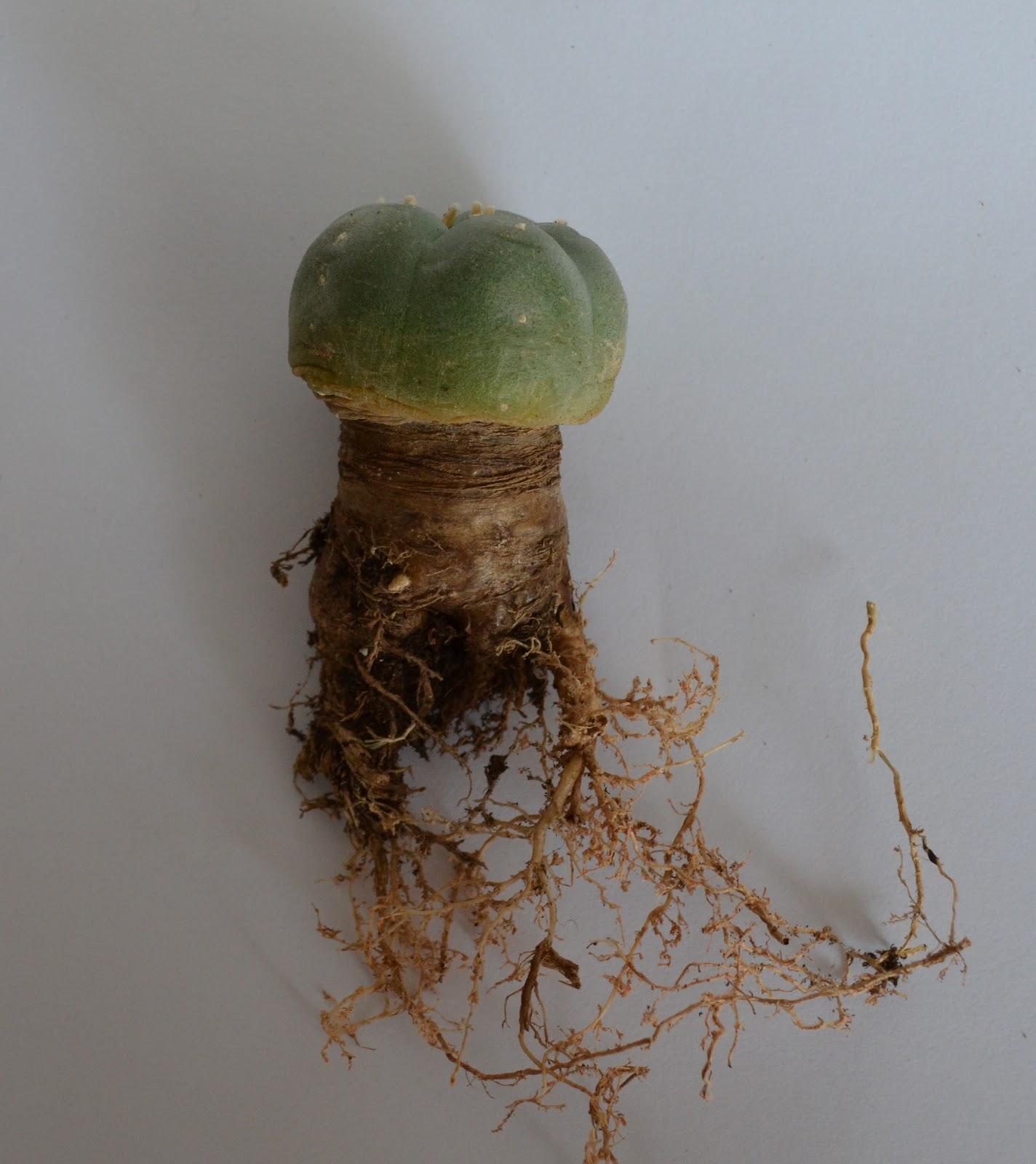
As you can see, the roots still contain a little bit of commercial mix (probably peat) that I just couldn't get off.
2011's seedlings
I'll let the following photos speak for themselves. One thing I would like to add is that you can really see the difference between the root-system of my seedlings and a L. williamsii grown in a peat based soil mix. I use a mineral soil mix that contains 70% fine grit and 30% cat litter. As mentioned in my previous article, you should only use cat litter if it doesn't turn in to pulp after standing a couple of days in water. I also recommend you to wash the litter a couple of times to get rid of the added odors.
Lophophora williamsii, 4 years old.
Lophophora williamsii, La Popa, Nuevo Leon, 4 years old.
Lophophora williamsii, Nuevo Yucatan, 4 years old.
2012's seedlings
Lophophora williamsii var. caespitosa is actually the same species as the normal L. williamsii, but is a hybrid, cultivated by selecting plants with many offsets. A normal L. williamsii can have the same appearance, but it's not guaranteed.
Lophophora williamsii var. Caespitosa, La Perdida, 3 years old.
Purchased in the end of 2014
Lophophora williamsii var. caespitosa, purchased last year.
As mentioned in the caption: the plant above is a L. williamsii var. caespitosa that I've bought last year. I just had to possess some older plants. More will be added to my collection soon (after the upcoming cacti show).
Re-potted
I was having doubts about what kind of pots I should use to re-pot them. I've decided to place them all in these two containers, because I think I'm using less space this way. I also think that it looks more organized.
Lophophora williamsii var. Caespitosa on the left and the normal Lophophora williamsii on the right.
Lophophora williamsii Nuevo Yucatan on the left and Lophophora williamsii La Popa, Nuevo Leon on the right.
The End
A short update on what I've sown this year: 40/40 Astrophytum caput-medusae up and the Sulcorebutia germination of this year sucks! (the rest is going average)
That's it for now. Have a nice day and till next time!
An article on my Lophophora williamsii collection! It ain't huge yet and I don't possess any plants that are mature enough to flower (this year just might prove me wrong!), but because of the fact that this is one of my favorite species, I feel like sharing them all at once!
Lophophora williamsii var. caespitosa
Let's kick-off with this new plant that I've bought in the end of last year. I haven't introduced it online till now, so: here it is! Another Lophophora williamsii! Caespitosa is a variety and not a different species. This variety is often a hybrid, but they can also pop up in a normal seed-tray and aren't even that rare in their natural habitat.
My Balcony-Greenhouse
Balcony-Greenhouse
It's cold outside and today and I'll have to turn on the heater a little bit today. Don't mind the mess! I'll clean it up in spring. ;-)
Lophophora williamsii collection
Where it all began...
Lophophora williamsii - Peyote
My first Peyote! I've bought this one in Amsterdam together with my wife. I was showing the city to her and of course also the famous Flower Market and there were a lot of cacti there! I have to be honest, because I normally complain about nursery-plants, there are some pretty plants around!
We've bought this plant because of its different appearance and squeezability. We didn't even know about the "magical" history and were quite amused after we've found out! Not that I've ever tried one, but this species is a curiosity for sure.
A couple of weeks later I've ordered a Peyote grow-kit @ Azarius.nl (I've also bought my San Pedro cutting there). The lack of knowledge in combination with a vacuum cleaner have made an end to this experiment (check out my older articles to see how that went!).
Sown in 2011
Lophophora williamsii
Lophophora williamsii - Peyote
No variety, just a "normal" Peyote! This means that the seeds were from cultivated plants without any trace of habitat.
Lophophora williamsii var. Nuevo Yucatan
Lophophora williamsii var. Nuevo Yucatan
The name of this variety comes from its origin. The seeds I've bought are probably from cultivated plants, but when you go a couple of generations back, you'll end up in the natural habitat of this species:
Nuevo Yucatan
Lophophora williamsii var. La Popa, Nuevo Leon
Lophophora williamsii var. La Popa, Nuevo Leon.
Same story, but there's something different about this variety. I don't know why, but I've had many survivors from this seed-badge. I've bought them at the same place as the ones mentioned above, but almost all of them have germinated and they just seem a little bit bigger and stronger than the others. I don't have an explanation for this...
Sown in 2012
Lophophora williamsii var. caespitosa
Lophophora williamsii var. caespitosa
Let's see if they'll have many heads within a couple of years. I've read that they'll start to sprout very young!
Now let me just show you a photo of these seedlings when they were only 2,5 months old:
Lophophora williamsii var. caespitosa, 2,5 months old
I'm showing this photo to you, because I would like to make some comparison to the ones I've sown last year.
Sown in 2013
Lophophora williamsii var. Cedral, SLP
Lophophora williamsii var. Cedral, SLP
2013, the year of DEATH! A huge tragedy has come over all the plants sown that year... As some of you remember, I've had some problems with the thermostat of my heater and simply fried everything I've sown!
BUT there are two survivors. Let's see if they still have it in them to become proud and mature Peyotes!
Sown in 2014
Lophophora williamsii var. Entronque, El Huizache
Lophophora williamsii var. Entronque, El Huizache
Something went wrong again! As you can see, they're all elongated. This normally means a lack of sunlight, but strangely all the other seedlings are looking normal! I've added a little fertilizer to the sowing-soil and I think that this was a huge mistake, because there was already some fertilizer in the potting-soil that I've used for my mixture. A good lesson for this year! I still hope that they'll get their natural look back and grow up pretty and all. We'll just have to be patient...
Above I've shown you a photo of some 2,5 months old L. williamsii var. caespitosa, which were also quite elongated and just check out how pretty they look in the first pic!
A special note on this badge is that I've sown them on the same day my son was born. Another reason why we all should hope for the return of a pretty and natural appearance!
The Great Poll
"The Great Poll" has ended this week! We have a winner!
The Great Poll
And the winner is.... 1. Astrophytum caput-medusae. Thank you, that's the most expensive one you could choose! That's no problem at all, because it's an awesome looking plant too and fits will very well in my collection. Remind me to give you one when they're older...
The End
All I can add is that I have good hope for a flower on one of the two older plants this year and that I might buy some older an ready-to-flower plants the next time I'm going to visit a cactus show.
Take care and till next article (which will be about pipes and something that I've added to my collection!)!
Welcome (back?) on my Blog! Sit back, grab a beer (or whisky), lit your pipe (or not) and get even more bored than you already were.
Every year around December and January I ask myself the same question: 'What will I sow this time?!'. Since 2010 I'm sowing each year on April the 1st and that day is coming closer and closer! If you're not an "Amateur-Cacti-Breeder" and/or collector yourself, you're probably wondering what the hell I'm talking about, but for me it has become a sort of addiction. Addicted to sowing cacti and other succulents! It sounds a little bit silly, but see it in a different way: I don't do heroin and I don't feel the urge to put things on fire. Accept for my tobacco and merchandise of The Doors, of course...
I'll keep it short! This is what I'm planning to sow:
Trichocereus pachanoi, the San Pedro cactus
I don't have any adult plants of this species yet, but here is the largest one I've got:
Trichocereus pachanoi
I've bought this plant in 2010 as a cutting and right now this San Pedro is the tallest one of my collection. It's a nice and easy plant to grow and I would like to have a couple of more. A little Google-research will teach you all about its "magical" abilities and there are a lot of cuttings and grow-kits on the market, but keep in mind that, although this plant isn't illegal, extracting mescaline from it and the possession of this drug is.
Growing cacti from the seed is fun in my opinion, but it takes more than just a few years till you have a decent size plant. Patience! That's the trick...
Sulcorebutia arenacea
This is a Globose-Flattened cactus from Bolivia that produces yellow flowers. I won't snatch any image, so here's a link to our great friend Google: Sulcorebutia arenacea
What can I say... I've tried to grow this plant before, but accidentally boiled the seedlings with a heater. It was a disaster that I'd prefer to forget...
Euphorbia obesa
A cool succulent from South Africa that I'm already wanting for a long time! I'll post some pics of my seedlings in the future, but feel free to Google.
Agave parryi
A winter-hardy Agave that should be able to grow outside here in The Netherlands! Let's see what the future will bring us. Of course I'll keep you informed.
Poll
And then there's the Poll! It seems that we have a winner, but it's still open till next week. What's it gonna be?! Scroll down and vote!
The End
This is it for today! I do have some news for you guys: 'Peyote News' is coming back! Next post will contain at least one part about our green/blue, friendly and spineless little friends!
Spoiler alert: a new member has joined the family!
Don't forget to vote! (and I'm not talking about politics)
Hello readers of my random blog! How are you all doing?! I'm doing just fine. Actually I'm doing great and I hope you do too (depending on who you are and if I like you or not). Today was just one of those Saturdays that I've had nothing scheduled. Nothing wrong with that! I actually like it when there is finally a day in the week that I don't have to do anything. Well... That's not completely true, because these days I'm a family-man, as you might know, and there is always something I have to do. But I like it when I'm not obligated to do other things than being a family-man. I won't type down everything I have done today, because it's all quite simple and regular. It started with a cup of coffee and ended with a beer and a Country Gentleman filled with Black Vanilla.
Why writing another article for your blog when there is nothing really different to mention? Well... I have no idea! Here is a video of my Balcony-greenhouse:
Why should we always do something "special" and "different" and why do we always want others to know about it? Probably we human beings do that because it's in our nature to be accepted by the rest of the herd. Everyone wants to be different and that is what makes us all the same. Kind of ironic, ah? Why not just be happy and satisfied with the regular things we do and appreciate the simplicity? Don't get me wrong! I believe that it's useful and enriching to think outside the box and do stuff we normally don't, but what is it worth and where is our identity when we're only focusing on being different and forget to stand still and appreciate the little things? I'm dreaming away here on a philosophical wave again... You don't have to agree with me and we can still be friends! I'm just writing down my thoughts...
Ah! Back to cacti! Here are my 2014 seedlings that I've sown in April this year:
Seedlings 2014
If you want to know what these green blobs will become, you should check THIS article. This year I'm keeping them in an aquarium, so that our dear friend Wonnebald can't pulverize my plants while stepping and jumping on them. I'll take some better photos when they're bigger and really look like cacti.
Here is a photo taken in my living room:
Cacti-bowl
This bowl looks interesting, right?! It's kind of growing out of hand! Now what do we have here? The thin, columnar cactus is a Cylindropuntia imbricata (the famous Cholla), the spineless one is my first Lophophora williamsii (Peyote), the one on the right is the famous Carnegiea gigantea (Saguaro) and the one that grows everywhere where it shouldn't grow is a Selenicereus grandiflora (Queen of the night). Now that is a handsome bowl, right?~!
And now we're going back to the balcony-greenhouse, a couple of weeks earlier:
A flowering Gymnocalycium saglionis
And that's about it for today. Take care and for the metal heads: I'm going to see Obituary tomorrow! HAH! \m/
First of all, here´s a short translation of the title for the NON-Dutchers: 'National Cacti and Succulent -day at Ubink in Kudelstaart'. Ubink is a cacti-nursery in Kudelstaart:
A = Ubbink, Kudelstaart
Believe it or not, but it took me almost three hours to get there! Some bad luck combined with disorientation did the trick. ;-)
Ubink's entrance with rock-garden
I have to be honest with you all about the fact that I haven't even noticed this beautiful rock-garden at the entrance at the time of my arrival. These first photos were the ones I've took after leaving the building, but I'll add them to the beginning because... Well! It's the entrance, duh!
Ubink's rock-garden
Now that's a nice rock-garden! Cacti outside in the Netherlands, is that even possible?! Yup, it is! But beware, because if you have a rock-garden like this, you'll have to bring all these big plants inside before the coming of winter. They're all in pots, covered by rocks and have a sublime drainage.
It is possible to have a cacti/rock-garden for the lazy gardeners among us. A lot of Opuntias and Cylindropuntias (and a couple of other species including some of Argentina) will survive a cold and wet climate like we have in the Netherlands. Good drainage is a must!
Let's enter! First of all, I would like to explain the setup. Ubink is a commercial cacti and other succulent nursery with the size of 50.000 square meters! That's huge! And because it's national cactus and succulent -day, they're open to the public and have reserved two halls for hobby cacti/succulent breeders to sell their surplus. I guess that one day I'll end up like one of them!
First I'll give you a quick impression, so that you can imagine the size of this place a little better.
That was quick, ah? Let's have a closer look. Here are some pics:
Ludwig Bercht (on the left) together with some fellow cacti-breeders, my type of people!
Earlier this year, I've ordered some seeds from Ludwig's website. Lophophora williamsii and Gymnocalycium berchtii (right, a plant that they have given his name!).
Ludwig's plants
"\]]]]]]]]]]]]]]]]]]]]]]]]]]]]]]===========================================================]]]]]]]]]]]]]]]]]]]]]]]]]]]]]]]]]]]]]]]]]]]]]]]]]]]]]]]]]]]]]]]]]]]]]]]]]]]]]]]]]]]]]]]]]]]]]]]]]]]]]]]]]]]]]]]]]]]]]]]]]]]]]]]]]]]]]]]]]]]]]]]]]]]]]]]]]]]]]]]]]]]]]]]]]]]]]]]]]]]]]]]]]]]]]]]]]]]]]]]]]]]]]]]]]]]]]]]]]]]]]]]]]]]]]]]]]]]]]]]]]]]]]]]]]]]]]]]]]]]]]]]]]]]]]]]]]]]]]]]]]]]]]]]]]]]]]]]]]]]]]]]]]]]]]]]]]]]]]]]]]]]]]]]]]]]]]]]]]]]]]]]]]]]]]]]]]]]]]]]]]]]]]]]]]]]]]]]]]]]]]]]]]]]]]]]]]]]]]]]]]]]]]]]]]]]]]]]]]]]]]]]]]]]]]]]]]]]]]]]]]]]]]]]]]]]]]]]]]]]]]]]]]]]]]]]]]]]]]]]]]]]]]]]]]]]]]]]]]]]]]]]]]]]]]]]]]]]]]]]]]]]]]]]]]]]]]]]]]]]]]]]]]]]]]]]]]]]]]]]]]]]]]]]]]]================================================================================================================================================================================================================================================================================================================================================================================================================================================================================================================================================================================================================================================================================================================================================================================================================================================================================================================================================================================================================================================================================================================================================================================================================================================================================================================================================================================================" Wonnebald, our cat, took control of the keyboard and this was his message, amen...
Lophophora williamsii
Beautiful plants! I've almost bought some of these, but decided not to. Now I'm wondering if you should have bought them or not..Hmmm....
More L. williamsii
Entering the nursery
50.000 square meters! That's a lot, you know? I was to lazy to take pictures of the whole place, so allow me to show you just a few.
These are the type of plants that you'll encounter in plant stores, mostly under a terrible condition. Here they're doing fine. In stores they give them light and water equal to the needs of each other plant they have and that just ruins a cactus!
Lophophora williamsii
These little guys cost € 1 each! That's cheap, considering that you pay at least € 6 for them at a normal store. And again I feel the cognitive dissonance... I should have bought some!
Echinocereus grusonii
Echinocereus grusonii and Ferocactus
Echinocereus grusonii and Ferocactus
Some large Cereus
Damage assessment
Waiting bored at the bus-stop, I've decided to make another photo:
Today's damage
Winter hardy Cylindropuntia
Cylindropuntia imbricata, Fremont, Colorado
This Cholla can withstand up to -25 degrees Celsius and will survive without covering it from rain. Like with all cacti, good drainage is necessary.
The plants I've bought from Ludwig Bercht:
Gymnocalycium quehlianum var. albispinum
Gymnocalycium horstii
Gymnocalycium denudatum
Euphorbia gorgonis
And last but not least; Euphorbia gorgonis. The Gorgons are the three daughters of the greek sea-gods Phorcys en Ceto. All three of them have living venomous snakes on their heads instead of hair. This is a succulent of the family Euphorbia.
Euphorbia gorgonis
Euphorbia gorgonis
Euphorbia gorgonis
Some literature
Cacti literature
'Cactussen' by W Cullman, an older book about cacti, but very informative.
'Wat betekent die naam', an excellent book that explains the meanings of all those botanical names.
'Succulenta', a number of 'Succulenta', a Dutch and Belgian magazine about cacti and other succulents.
'Gids voor ziekten en plagen in huis en tuin', a small book about plant diseases and products to cure them.
The end
And that's about it. It was a good decision of me heading alone to Kudelstaart. I felt like a kid in a candy-store with all those cacti and other succulents around me for very low prices. To only thing that concerns me is space... Always space! I love our apartment and I think we'll live here for a couple of more years, so I'm stuck with two balconies for now. I'm thinking about building a greenhouse on my own. A little bit larger and stronger and with a good regulation of heat and fresh air. Right now I'm doing fine, but I can do better!
Life's still good to me and I'm living a happy one with my amazing wife and extremely well-growing son Arthur. Things are looking good and everything seems to be back on track (the birth of a child changes everything!).
The upcoming blog will be probably about a PRF-Pipe-smokers meeting at Schimmel Sigaren in Zutphen, one of the oldest and more specialized tobacco stores in Holland.